


Tuan Andrew Nguyen’s sandstone and copper version of the destroyed Bamiyan Buddhas reminds passersby that history repeats itself.

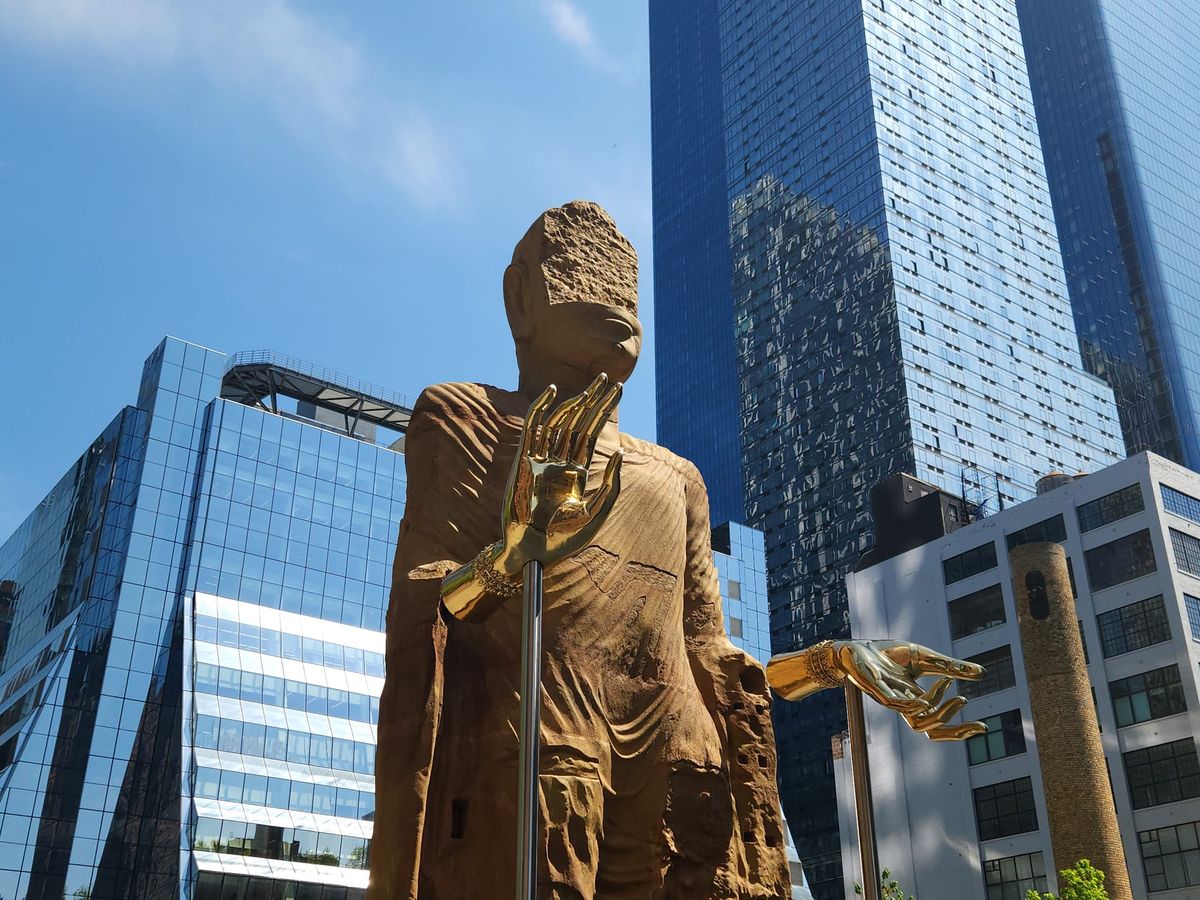
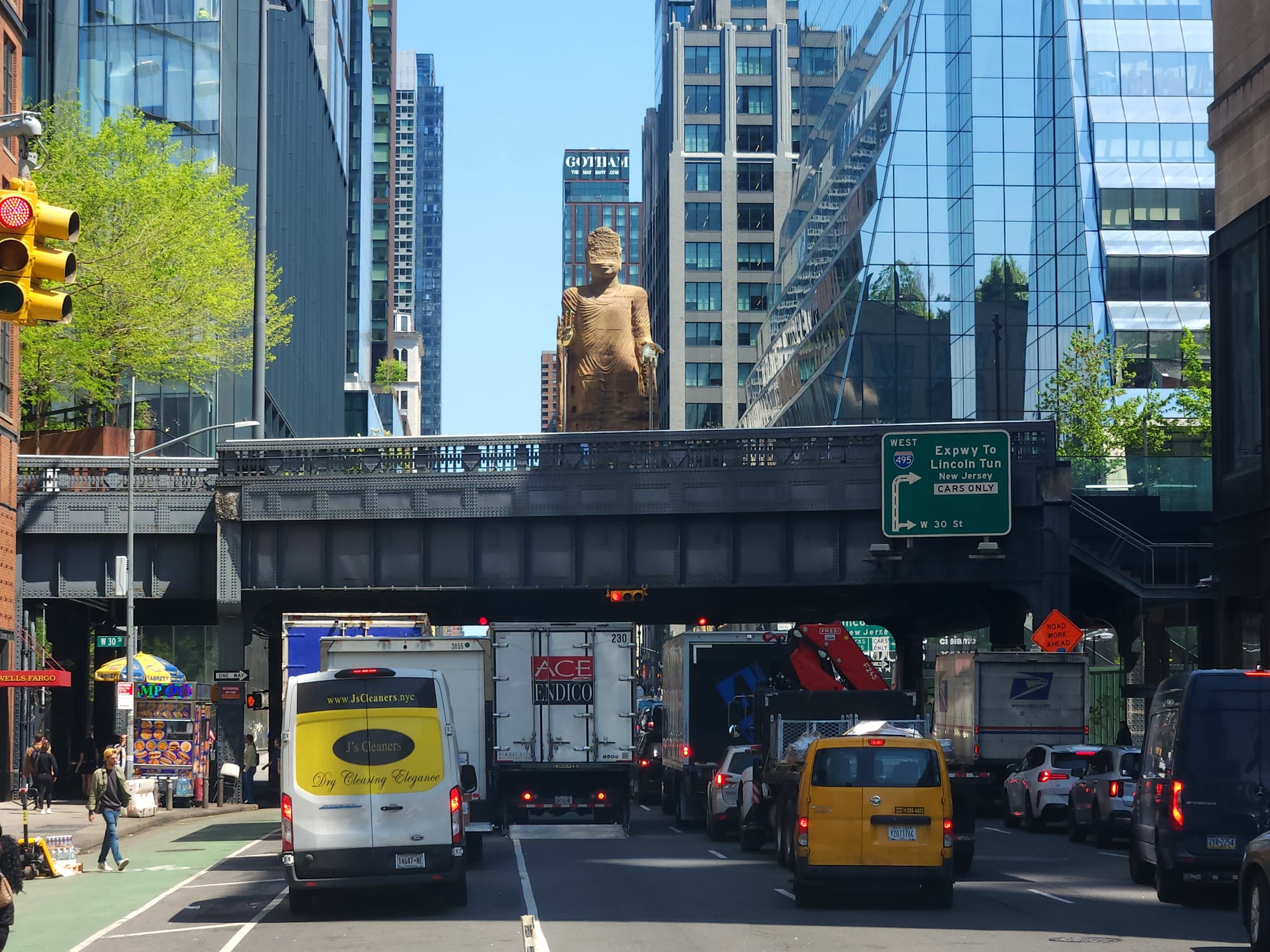
Among the sea of sky-blue high-rise buildings windows and traffic flowing toward the Lincoln Tunnel, a large sandstone Buddha stands high on the High Line, inviting Manhattan to embrace a moment of tranquility.
Tuan Andrew Nguyen’s “The Light That Shines Through the Universe” (2026), the park’s fifth site-specific commission, was selected from nearly 60 proposals. It was recently installed at West 30th Street and 10th Avenue, and will be on display through the spring of 2027. The 24-foot-tall sculpture stands out from its contemporary surroundings not only for its warmth and worn quality, but also because it captures the a crucial piece of destroyed cultural heritage: the Bamiyan Buddhas.
“This sculpture creates friction with the environment here in New York. It’s not sleek like everything else you can see here,” Cecilia Alemani, art director and chief curator of High Line, told Hyperallergic. “It gives the audience a hint that temporality is not necessarily a straight line, that things can come back almost like on a wheel.”
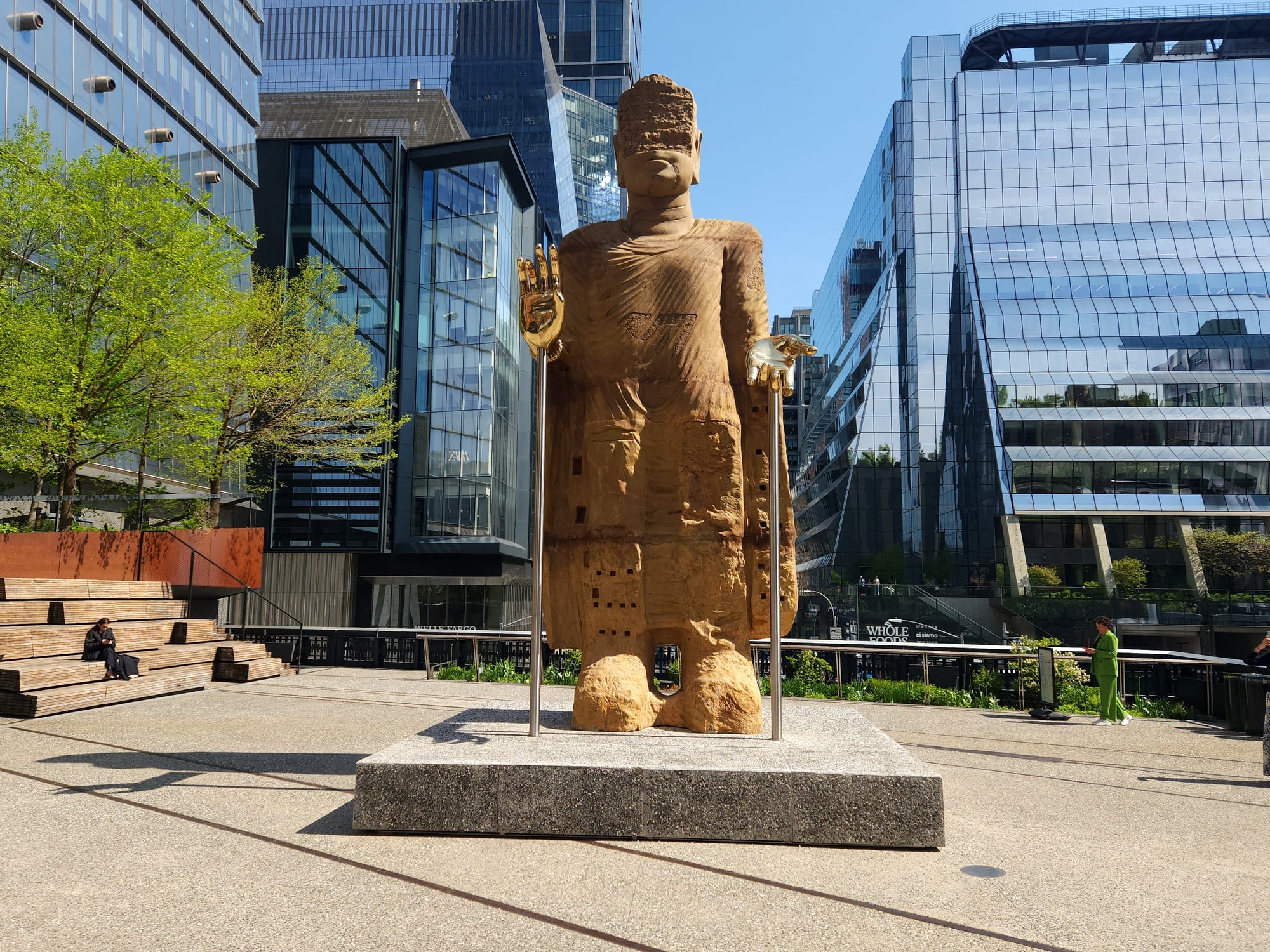
The Bamiyan Buddhas, massive reliefs dating to the 6th century, were carved into a sandstone cliff of Afghanistan’s Bamiyan Valley, a region along the Silk Road trade route that became a prominent Buddhist site. Of the two figures, the larger Buddha was affectionately called “Salsal,” which translates to “the light shining through the universe,” also the title of Nguyen’s work. Beloved for their historical significance and symbolism of cross-cultural exchange in the area, the Bamiyan Buddhas were sadly destroyed by the Taliban in 2001 in an act of iconoclasm.
Nguyen, who in his practice has rearranged or reinterpreted artillery associated with the Vietnam War, used the same approach to create the sculpture’s hands, which are separate from the sandstone body. He told it Hyperallergic that he was able to source artillery brass from Afghanistan through a friend’s network in the Bamiyan region and bring it across the Pakistani border. He rearranged them into the shapes of that mudras – symbolic hand gestures widely used in Buddhist and Hindu iconography – before being transported to Vietnam, where the sandstone was quarried and carved.
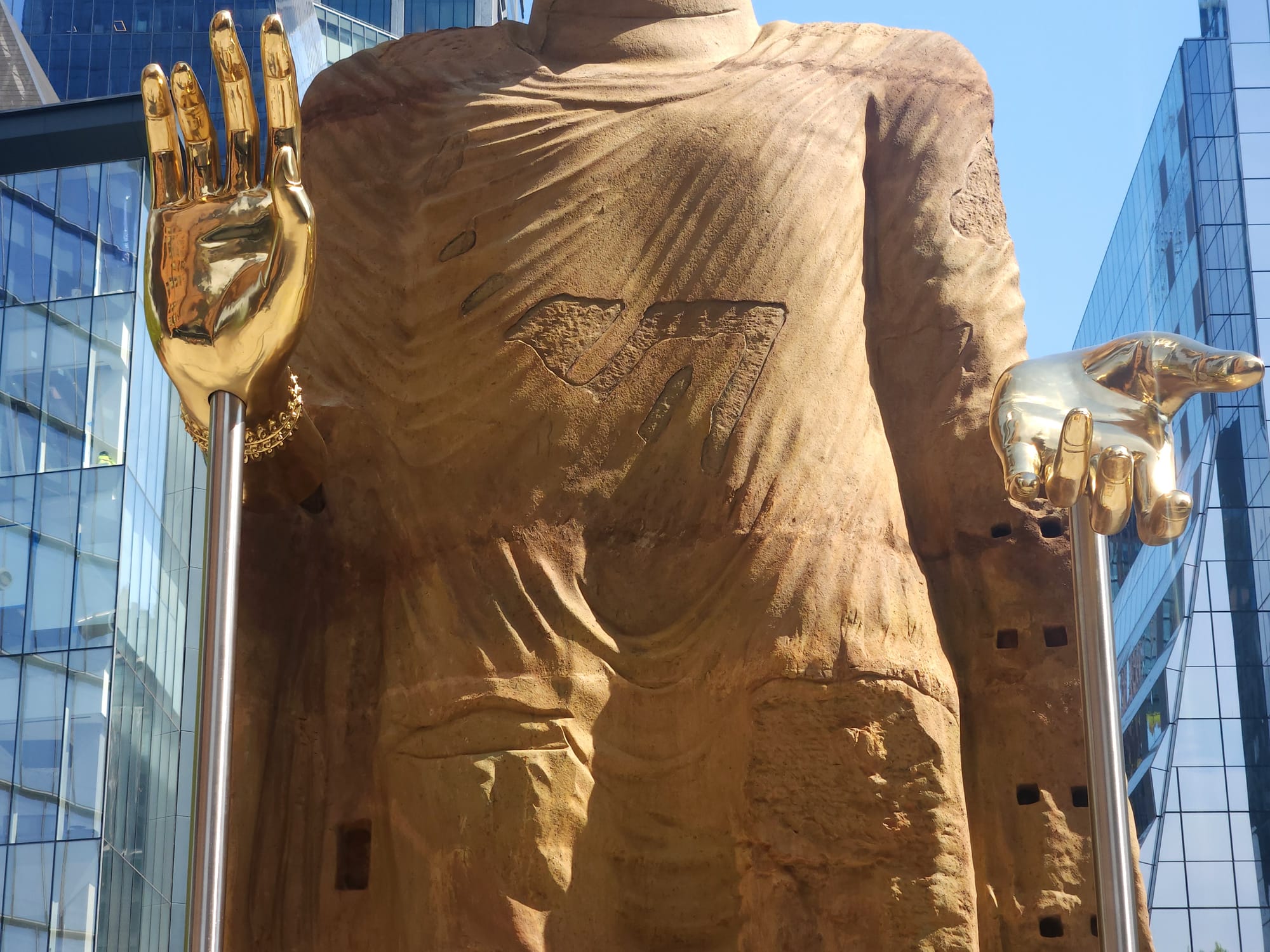
The right hand glints through the sun above us and calls out the Abhaya mudra, meaning fearlessness, while the left hand connotes compassion and sincerity Varada mudra.
said Nguyen that his statue was not a replica of the lost cultural heritage, but rather an ‘echo’.
“You keep a story, idea or memory alive by retelling it,” he explained. “When I participate in this process of remaking, it is as if I am retelling the story. It is translated through my hands and eyes.”
Although it seems particularly timely due to the ever-evolving developments led by the United States and Israel violence in Iran, Alemani noted that Nguyen’s proposal had been selected long ago. “It is a testament to the power of the artist’s voice that the works we select sometimes become even more relevant when we install them,” said Alemani.
Amid today’s chaos, Nguyen’s Buddha looks out over Manhattan, a symbol of compassion and resilience.


