


Layer-1 blockchains will come under increasing pressure to sacrifice decentralization for speed and efficiency as adoption of the technology grows, according to Eric Chen, CEO of Injective.
This pressure will come from the need to meet users’ desires for faster speeds or more block space for higher throughput, Chen told Cointelegraph’s Chain Reaction podcast on Monday.
“In our minds, it’s really about finding opportunities to scale without compromising the fundamental pillars that define what a blockchain is,” he said.
As blockchain adoption accelerates due to institutional adoption and AI funding, this tension is about to be tested on a much larger scale. Part of crypto’s original purpose was to create a ‘trusting’ financial system in which individuals could transact without having to rely on traditional intermediaries.
Centralization brings risks
Chen said centralize is the easy way out – “it could be a very, very easy choice to move everyone into the same data warehouse, or literally have a leader validator calling the shots for everyone” – but warned that this creates a single point of failure: “If that one server has a particular error, the whole chain breaks down.”
Related: DAOs may need to forego decentralization to judicial institutions

Eric Chen talks to Ciaran Lyons about the Chain Reaction. Source: Muntelegraaf
Chen added that for injective – an interoperable layer 1 blockchain designed for DeFi applications – it’s about “coming up with ways to optimize the entire chain,” and there are other ways to do this without reducing block time.
One option he suggested was “location scaling,” where there are “specific zones” and layer 2 scaling to ensure all high-demand transactions can get through.
“It’s always an ongoing tug-of-war, and it’s about keeping the fundamental pillars and then seeing where the space moves.”
The blockchain trilemma remains a challenge
It is said that the perfect blockchain has three elements: security, decentralization and scalability. The principle of the blockchain trilemma is that it is only possible to fully optimize two of the three properties at the same time.
Decentralization means there is no single point of control, with many independent participants validating the network. Security means resistance to attacks, fraud and manipulation. Scalability means the ability to handle high transaction volumes quickly.
Putting too much pressure on one, such as scalability, will result in sacrificing another, such as decentralizationChen said.
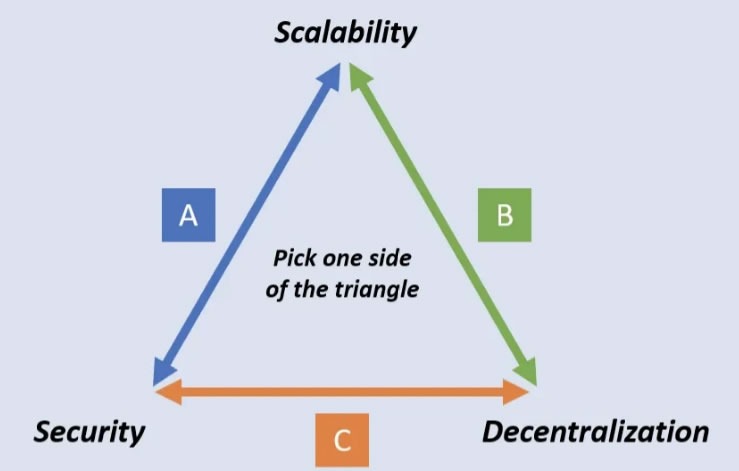
The blockchain trilemma. Source: OKX
Magazine: AI is banking the unbanked in Africa… faster than crypto
Credit : cryptonews.net


